Batu Caves Dress Code: What to Wear for Women, Men and Children

Quick Answer: Batu Caves Dress Code
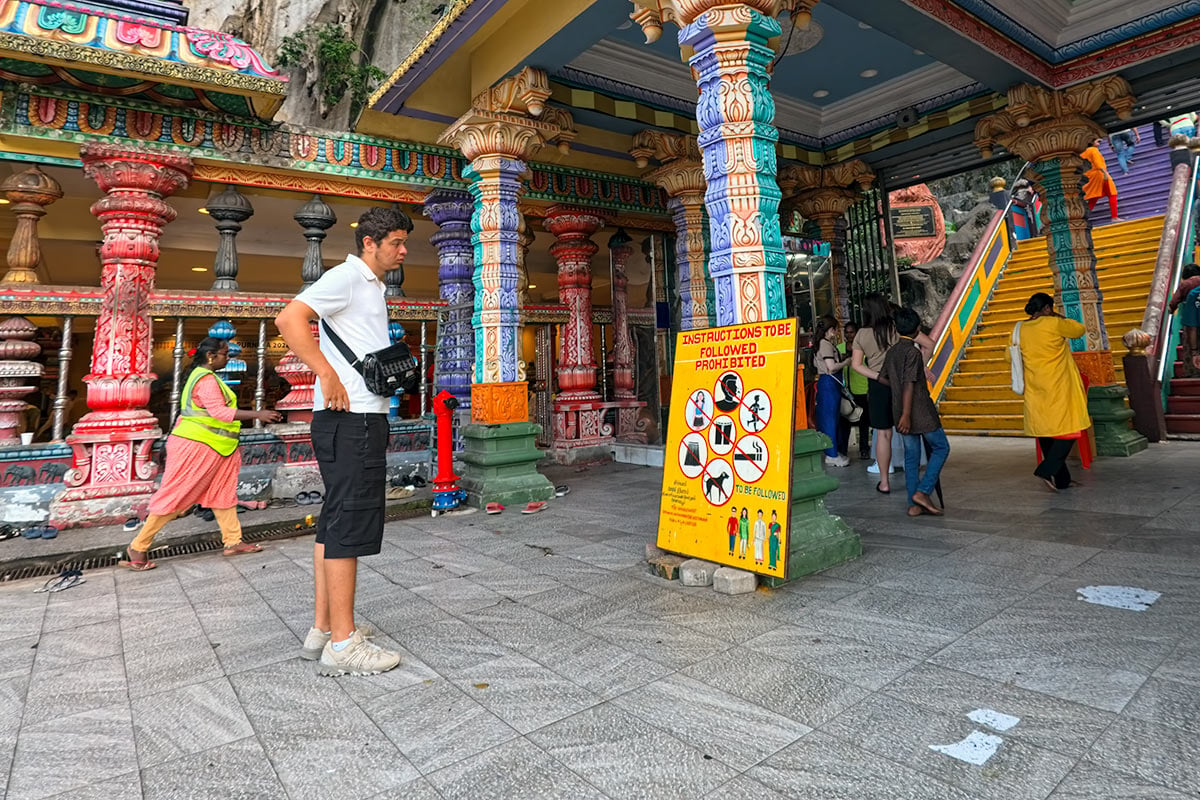
Shoulders and knees must be covered to enter the Temple Cave. The rule applies equally to women and men, is actively enforced at the base of the 272-step staircase, and there are no exceptions. Sarongs are available to purchase on-site for RM15 cash — not rental, purchase.
✅ Allowed: Sleeved tops · knee-length or longer shorts · long trousers or maxi skirts/dresses that cover the full leg · sleeveless top with shawl over shoulders
❌ Not allowed: Sleeveless tops without cover · shorts above the knee · singlets or muscle tees · beachwear or crop tops
⚠️ Skirts and dresses that fall at knee length may be refused at the entrance — enforcement is at the volunteer’s discretion. If you are wearing a skirt, bring a sarong to wrap over it or choose trousers instead. A maxi skirt or dress that covers the full leg is the safest option.
The dress code applies to the Temple Cave only. No clothing requirements at the forecourt, Ramayana Cave, or Cave Villa.
| BATU CAVES DRESS CODE — QUICK FACTS | |
|---|---|
| Dress code enforced at | Temple Cave staircase entrance only |
| What must be covered | Shoulders and knees — both, for women and men |
| Sarong available on-site | Yes — purchase only, RM15 cash (no rental, no card payment) |
| Children | Same rules apply from approximately age 10 and above |
| Footwear on the staircase | Shoes on — grip-sole sandals or closed-toe shoes recommended |
| Footwear inside shrines | Shoes and socks off before entering any individual temple or shrine |
Batu Caves, located 13km north of Kuala Lumpur, is home to Sri Subramaniar Swamy Temple — an active Tamil Hindu place of worship and one of Malaysia’s most significant pilgrimage sites. A modesty-based dress code applies to all visitors entering the Temple Cave: shoulders and knees must be covered for both women and men, enforced consistently at the base of the 272-step staircase throughout the day. For a full overview of the site, its attractions, and how to plan your visit, the Batu Caves Visitor Guide covers everything in one place.
This guide covers the Batu Caves dress code in full — what to wear as a woman or man, how the rules apply to children, what happens if you arrive underdressed, how footwear works on the staircase and inside individual shrines, and what changes during Thaipusam and major festivals.
Quick Dress Code Checklist for Batu Caves
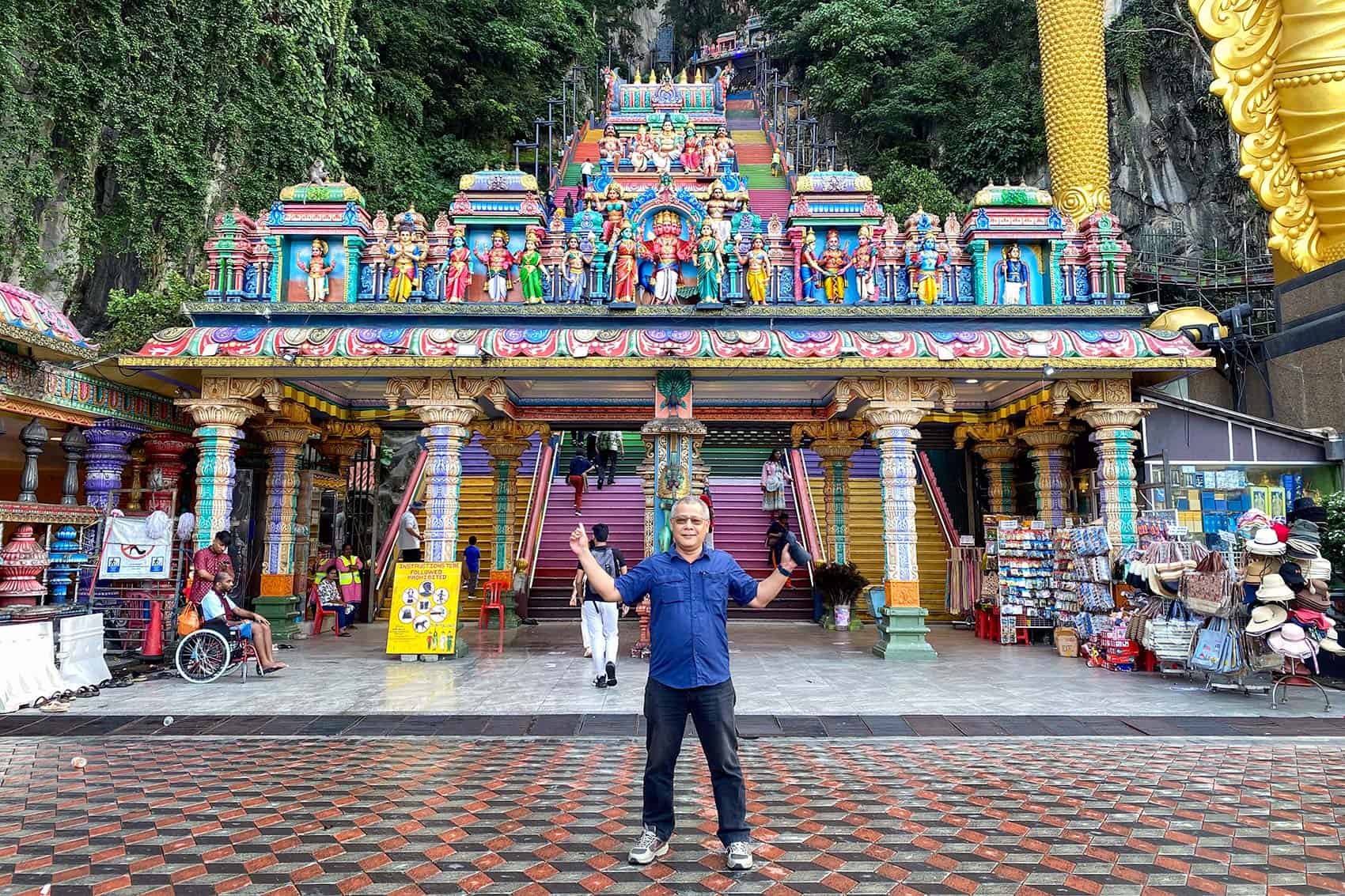
The Batu Caves dress code requires covered shoulders and covered knees for entry to the Temple Cave. The checklist below gives you the complete picture before you pack — every item of clothing that passes, every item that will be refused at the entrance, and the specific skirt and shorts rules that catch most first-time visitors off guard.
✅ Allowed at Batu Caves
- T-shirts or tops with sleeves
- Long trousers or pants
- Knee-length shorts (at or below the knee)
- Maxi skirts or dresses falling below the knee
- Sleeveless top + shawl or scarf covering the shoulders
- Comfortable walking shoes or secure sandals with grip
❌ Not Allowed at Batu Caves
- Short shorts or mini skirts (above the knee)
- Tank tops, tube tops, or spaghetti-strap tops worn without a cover
- Sleeveless muscle tees or singlets (men)
- See-through, sheer, or skin-tight clothing
- Shirtless entry (men)
- Beachwear, swimwear, or crop tops
⚠️ Skirts and dresses that fall at knee length may be refused at the entrance — enforcement is at the volunteer’s discretion. If you are wearing a skirt, bring a sarong to wrap over it or choose trousers instead. A maxi skirt or dress that covers the full leg is the safest option.
The checklist above applies at the base of the 272-step staircase — the entry point to the Temple Cave. It does not apply at the forecourt, the Ramayana Cave, or the Cave Villa. If you are staying at ground level, the clothing you travelled in is fine.
Is There a Dress Code at Batu Caves?
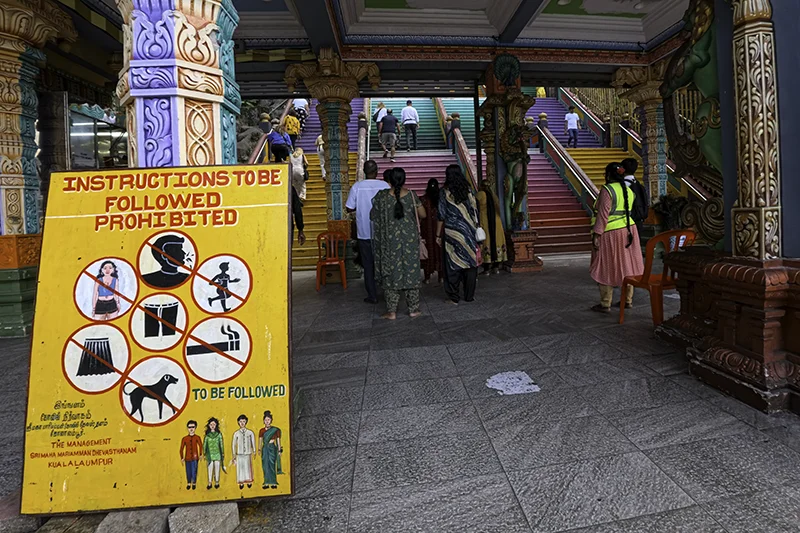
Yes. Batu Caves enforces a modesty-based dress code for all visitors entering the Temple Cave. Both shoulders and knees must be covered, and this requirement applies equally to tourists and locals, men and women, throughout the day.
The check happens at the base of the 272-step staircase. There is no quieter window when enforcement is relaxed — temple staff and volunteers apply the requirement consistently during all Batu Caves opening hours. Visitors whose clothing does not meet the requirement are asked to purchase a sarong (RM15, cash) at the staircase base before proceeding.
Where Is the Dress Code Enforced at Batu Caves?
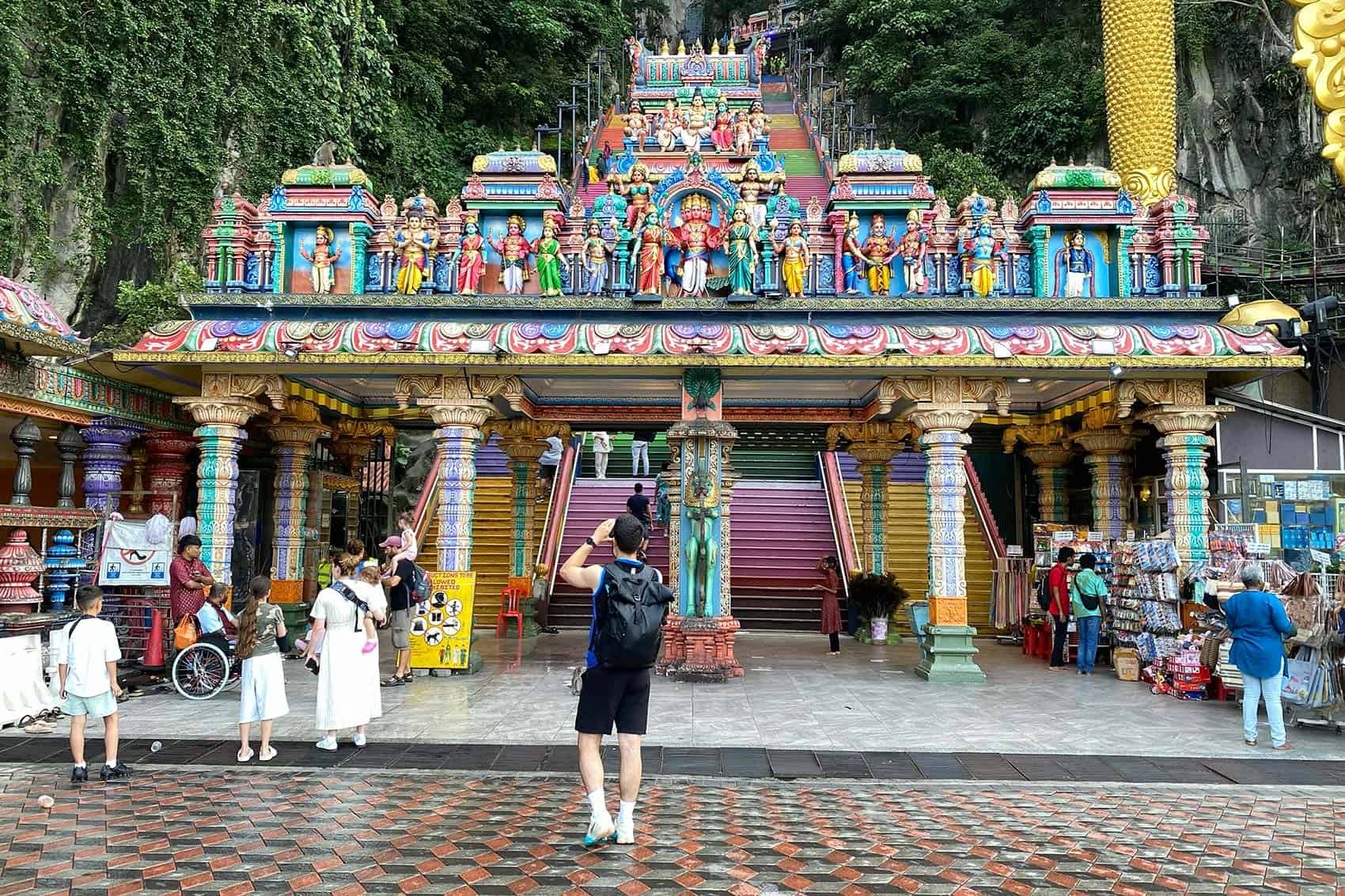
Not the entire complex — only the upper zone. Here is exactly where the line falls.
Where the dress code is required
272-step rainbow staircase, Temple Cave, and all inner temples
The dress code is enforced from the moment you approach the base of the staircase to climb. Temple staff and volunteers inspect clothing before visitors are permitted to proceed. Shoulders and knees must be covered — and that requirement stays in place continuously through the full climb, inside the Temple Cave at the top, and inside every individual temple and shrine within the complex. Once you enter this zone, you must remain dressed to the standard for the full duration of your visit. There is no point in the upper section where the dress code no longer applies.
Note — additional footwear rule inside individual shrines
When entering any individual shrine within the upper cave, shoes and socks must also be removed. This is a separate requirement from the dress code — it applies on top of it. There is a shoe-removal area just outside each shrine entrance; follow the signs or mirror what the visitors ahead of you do.
Where no dress code is required
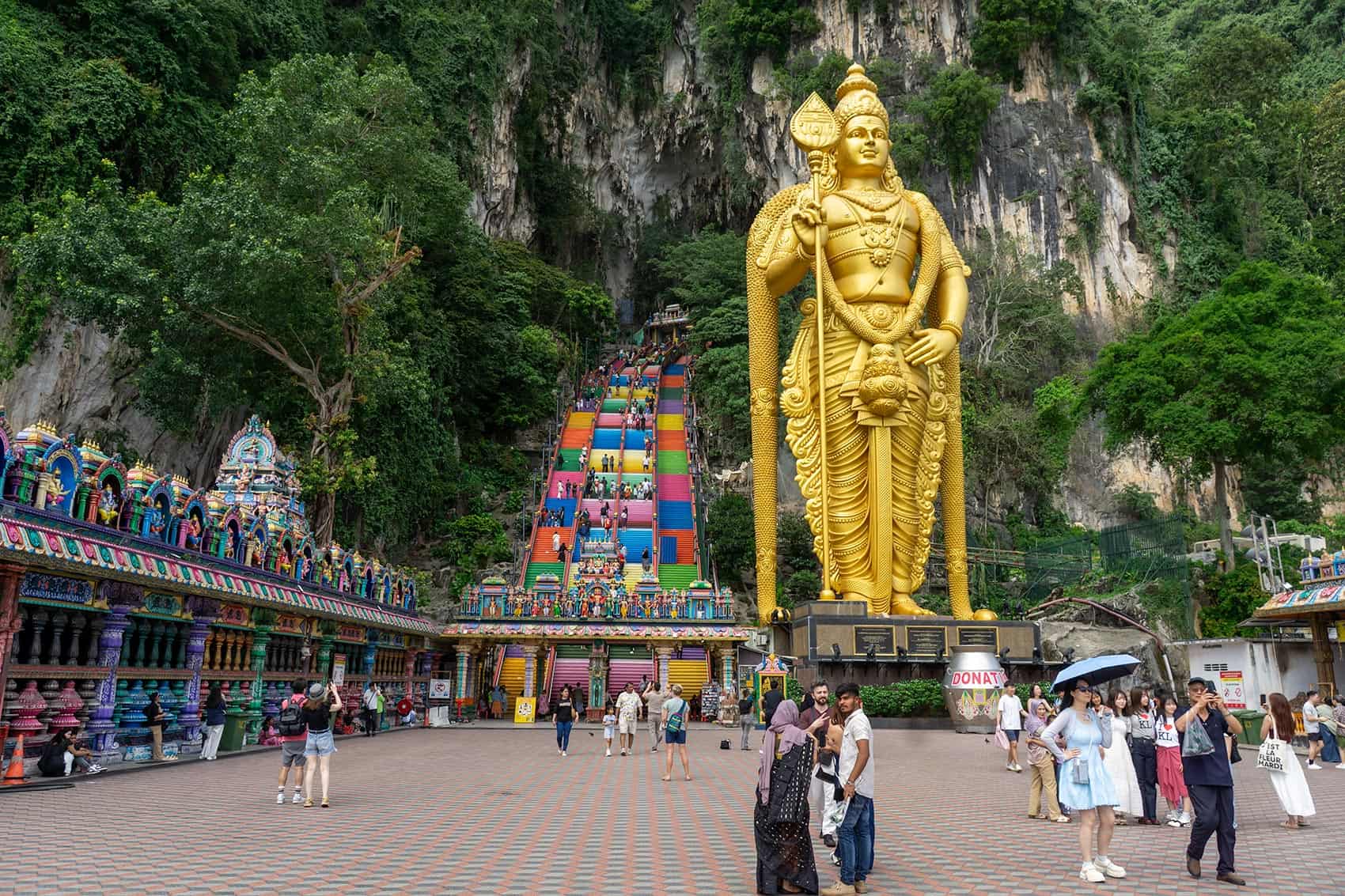
Forecourt and Lord Murugan statue area
The open forecourt at ground level — including the area around the Lord Murugan Statue, the 42.7-metre golden statue at the foot of the staircase — has no dress code. Shorts, sleeveless tops, and casual travel clothing are all fine here.
Ramayana Cave
A ground-level attraction with its own entrance and admission fee. No dress code applies. Visitors in shorts or sleeveless tops can enter without a cover-up.
Cave Villa
Also at ground level, with a separate entrance. No modesty requirement applies here either.
Most Popular Evening Tour From Kuala Lumpur
From Batu Caves to Fireflies in One Unforgettable Evening
By 3pm you’re picked up from your hotel. Within the hour you’re climbing 272 rainbow-painted steps to an ancient Hindu temple set inside a limestone cave. After dark, you’re on a boat drifting down the Selangor River as thousands of fireflies pulse through the mangroves in perfect unison — one of the rarest natural sights in Malaysia. Two completely different experiences. One private tour.
Rated 4.8/5 from 494 verified reviews on TripAdvisor, Google and Viator.
Batu Caves Dress Code for Women
The Batu Caves dress code for women follows the same rules as for men — shoulders and knees covered — but women are the most commonly stopped group at the staircase entrance because standard tourist clothing (sundresses, tank tops, shorts above the knee) tends to fall outside what the temple requires.
What works for women at Batu Caves
- A light t-shirt or cotton blouse with sleeves, paired with long trousers or a skirt falling below the knee
- A midi or maxi dress that covers the knee — one of the most practical choices in Malaysia’s heat
- Shorts sitting at or below the knee, paired with a short-sleeved or sleeved top
- A sleeveless top or sundress worn with a lightweight shawl or scarf draped over both shoulders
What gets women turned away
- Sundresses with thin or spaghetti straps worn alone, without a cover over the shoulders
- Shorts or skirts sitting above the knee — even by a few centimetres — are consistently refused
- Crop tops, backless tops, or tops with low necklines, regardless of how much leg is covered
- Sheer or see-through fabrics that do not effectively cover the skin
Practical notes for women
The most versatile packing choice is a lightweight shawl or cotton scarf. It weighs almost nothing, packs flat, and converts any sleeveless top into a compliant outfit in seconds. Linen and cotton breathe best in Malaysia’s humidity — anything synthetic will feel uncomfortable before you have finished the climb.
If you are wearing a skirt, bring a sarong regardless of the length. Wrapping it around the waist adds a second layer of certainty at the entrance check — and solves the staircase visibility problem at the same time.
If you arrive without a cover-up, sarongs are sold at the staircase base for RM15 cash. There is no sarong rental at Batu Caves — this is a purchase, not a loan.
Batu Caves Dress Code for Men
Men generally find the dress code simpler to meet. A standard t-shirt and knee-length shorts is enough — the rules are not complicated.
What works for men at Batu Caves
- Any short-sleeved or long-sleeved t-shirt or collared shirt
- Knee-length shorts — sitting at the knee or below
- Long trousers of any style
What gets men turned away
- Sleeveless muscle tees, gym singlets, and tank tops — consistently refused at the entrance
- Basketball shorts, board shorts, running shorts, or gym shorts that sit above the knee
- Shirtless entry of any kind
Common mistake for male tourists
Many men travelling from beach destinations or packing light for Kuala Lumpur bring athletic or gym shorts. These often sit above the knee and will be refused. If your shorts are borderline, pack the longer pair. Sorting out a sarong cover-up at the base of 272 steps in 32°C heat adds unnecessary time and effort to the start of your visit.
Men can purchase a sarong at the staircase base for RM15 (cash, no rental). Wrapping it around the waist as a skirt overlay works as a practical solution for shorts that fall just short of the requirement.
What to Wear to Batu Caves

To meet the dress code and stay comfortable during the climb and temple visit, plan your outfit with both modesty and Malaysia’s humidity in mind.
- Cover shoulders: Pair a sleeveless top with a lightweight shawl, scarf, or thin outer layer.
- Cover knees: Long trousers, a maxi skirt, or a sarong wrap all work.
- Carry a backup: A lightweight scarf or shawl takes up no space in a bag and solves most dress code problems before they start.
- Choose the right fabric: Lightweight cotton or moisture-wicking blends stay comfortable on the staircase. Heavy or synthetic fabrics trap heat and make the climb harder than it needs to be.
- Arrive prepared: Sarongs are available for purchase at the staircase base (RM15, cash), but buying one on arrival adds time. Planning your outfit the night before costs nothing.
If you would rather not think through the logistics, a private Batu Caves tour includes dress code guidance before pickup — useful for visitors arriving early from KLIA or working to a tight schedule.
What Not to Wear at Batu Caves

To meet the dress code requirements at Batu Caves and avoid being stopped at the entrance to the Temple Cave, visitors should avoid clothing that does not meet modesty standards. In practical terms, the following items are not permitted inside temple areas:
- Short shorts or mini skirts: Shorts must reach the knee or below. Clothing that sits clearly above the knee may be refused entry.
- Sleeveless or low-cut tops: Tank tops, camisoles, and tops with low necklines require a shawl or cover-up.
- See-through or skin-tight clothing: Sheer fabrics, exposed midriffs, backless tops, or outfits that reveal significant skin are not acceptable.
- Beachwear or swimwear: Clothing designed for the beach or pool is not suitable for a temple environment.
- Hats or caps inside temple areas: Headwear should be removed when entering the Temple Cave.
- Men’s clothing flagged for entry: Sleeveless muscle tees, singlets, and deep-cut tank tops are not permitted. Basketball shorts, gym shorts, and running shorts that sit above the knee may also be refused. Knee-length shorts with a regular t-shirt will pass without issue.
As a general rule, clothing that would be considered inappropriate in other religious spaces should be avoided here. Choosing conservative attire helps ensure smooth access to the Temple Cave and avoids the need to change or borrow coverings on arrival.
What Happens If You Don’t Meet the Batu Caves Dress Code
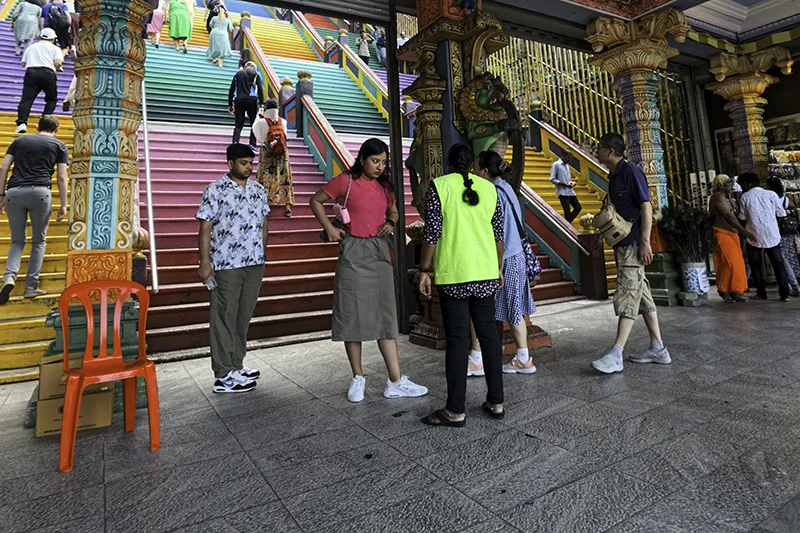
Visitors whose clothing does not meet the dress requirements are stopped at the base of the staircase before the climb begins. There is no way around this — enforcement is consistent throughout the day.
Asked to cover up: Visitors in shorts above the knee or sleeveless tops are asked to purchase a sarong at the staircase base before proceeding. The sarong costs RM15 cash — no rental, no card payment, no exceptions.
Denied access if you refuse: Visitors who choose not to cover up are not permitted to climb to the Temple Cave. This applies regardless of nationality or how the request is made.
Added time: Stopping to buy and arrange a sarong at the staircase base adds 10–15 minutes to your visit — worth factoring in if you have a timed connection or a pickup after Batu Caves.
Deciding your outfit the night before costs nothing and avoids all of this. For guidance on the best arrival times and crowd levels at the entrance, see the best time to visit Batu Caves.
What to Wear on Your Feet at Batu Caves
For the 272-step staircase at Batu Caves, wear closed-toe shoes or sandals with a grip sole. The steps are concrete, become slippery after rain, and most slips happen on the descent rather than the climb — grip matters more on the way down than on the way up. Flip-flops are workable on dry days but unreliable when wet.
The Batu Caves staircase guide covers what to expect from the climb in full — step count, gradient, rest points, and how long it typically takes.
You may see Hindu pilgrims completing the climb barefoot. This is a personal act of devotion, not a requirement for visitors — tourists keep their shoes on for the full staircase.
Inside the temples and shrines: Shoes and socks must be removed before entering any individual temple or shrine within the upper cave complex. This is a separate rule from the dress check at the staircase base — it applies once you are inside the cave, not before. There is a shoe-removal zone just outside each shrine entrance. Follow the signs, or mirror what the visitors ahead of you do.
The cave temple floors are stone and feel cold underfoot, particularly early in the morning. Shoes or sandals you can slip on and off easily are more practical than laced boots for this visit.
Do the Dress Code Rules Apply to Children?
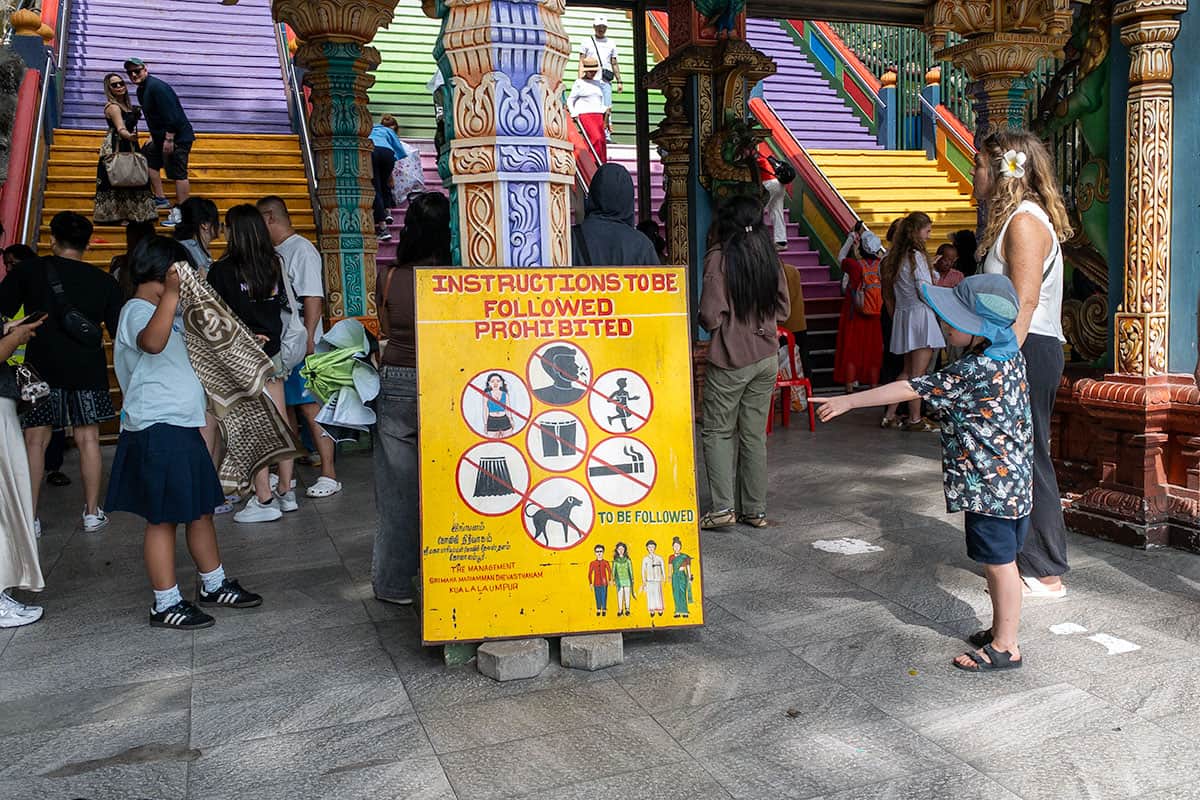
Strict enforcement does not apply to young children. Temple staff apply common sense with families — no one will stop a toddler or a five-year-old in shorts at the staircase entrance.
For older children — roughly ten and above — the same rules apply as for adults. A teenager in short shorts or a sleeveless top will be stopped at the staircase base. Packing a lightweight sarong as a backup for children in this age group is the simplest way to avoid a delay at the entrance.
Dressing children modestly is worth doing regardless of where enforcement begins. It removes any uncertainty at the entrance check and sets the right tone for the visit.
Batu Caves Dress Code During Thaipusam and Special Events
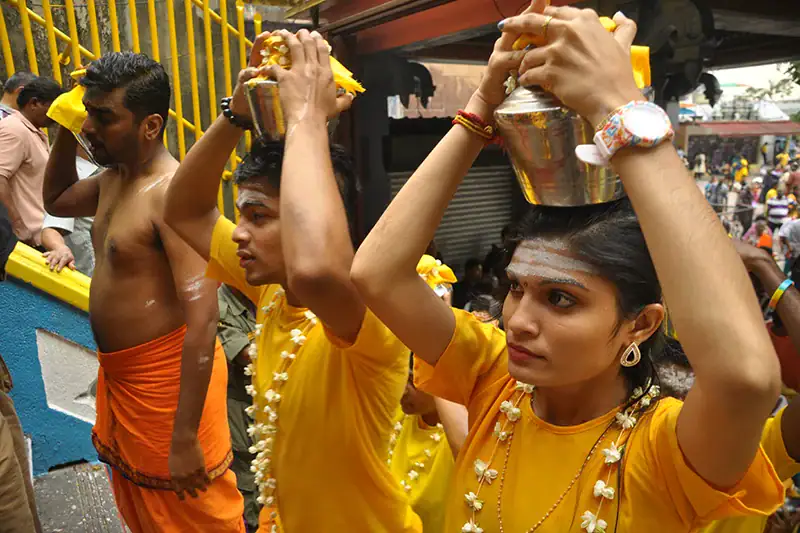
The dress code during Thaipusam is exactly the same as on any other day. There is no relaxed or alternative dress code for festival visits — if anything, enforcement is more consistent due to the higher volume of visitors and active crowd management at entry points.
During Thaipusam, many Hindu devotees wear yellow or saffron-coloured clothing. Yellow carries specific meaning in Hindu tradition — it represents purity, devotion, and spiritual discipline. Devotees observe a vow (vratham) in the days or weeks before the festival, and wearing yellow is part of that commitment. Tourists are not expected to wear yellow. The standard dress requirements apply.
A few practical notes for festival visits:
- Allow additional time at the entrance — dress checks take longer during peak crowd hours
- Give clear space to devotees carrying kavadi or ritual offerings — do not block their path or photograph them closely without awareness
- Follow any on-the-day instructions from temple staff immediately — crowd logistics are managed actively during major festivals
Behaviour and Etiquette Inside the Temple
The dress code is the most visible requirement at Batu Caves, but there are a few other points worth knowing before you go in.
Keep your voice down inside the cave and near the shrines. Noise carries significantly in an enclosed cave environment, and worshippers are present throughout the day.
Avoid pointing directly at shrines or religious statues with a single finger. In Hindu temple culture, this is considered disrespectful. Use an open hand to gesture if needed.
Photography is permitted throughout the complex, including inside the Temple Cave. Avoid photographing worshippers closely during prayer or active ritual without any acknowledgement. A moment of eye contact or a brief nod is enough — it changes the dynamic entirely.
Follow instructions from temple volunteers immediately and without debate. If you are asked to remove shoes, step back from an area, or wait before entering a space, do so.
For visitors who want cultural and religious context for what they are seeing, a local guide at Batu Caves provides that in real time — including the history of individual shrines, the significance of festival rituals, and context that is not written on any signboard.
Private Half-Day Tour · Kuala Lumpur
Batu Caves and Kuala Lumpur’s Highlights — One Private Morning
Early 7.30am start means you hit Batu Caves before the heat builds and the tour coaches arrive — 272 rainbow-painted steps with space to breathe, not shuffling through a crowd. By mid-morning the city opens up: Petronas Twin Towers, Merdeka Square, Thean Hou Temple. No chocolate boutique, no pewter factory — just the places that actually show you how Kuala Lumpur is built and why it looks the way it does. Local tips throughout — the best places to eat, where to shop without the tourist markup, and the spots locals actually hang out. Half a day. Full picture.
Rated 4.8/5 from 494 verified reviews on TripAdvisor, Google and Viator.
Dressing for the Weather While Meeting the Dress Code
Shoulders and knees covered, comfortable walking shoes, and lightweight breathable fabric. In Malaysia’s heat and humidity, fabric choice matters more than tourists expect — cotton and linen stay comfortable on the 272-step climb; synthetic fabrics trap heat in a way that makes the ascent noticeably harder. If you’re visiting between October and March during the wet season, quick-dry materials are worth the extra thought.
Batu Caves is typically the first stop on a Kuala Lumpur city tour — and the same dress code applies for the full day. Dressing right for Batu Caves in the morning also covers you for Thean Hou Temple and any other place of worship on the afternoon itinerary. If you’re combining Batu Caves with KL’s main landmarks in one day, the city tour guide covers how the day is structured and what to expect at each stop.
Frequently Asked Questions About the Batu Caves Dress Code
Information last verified: June 2026. Sarong purchase price, opening hours, and entry policies are subject to change — confirm before visiting.